Abstract
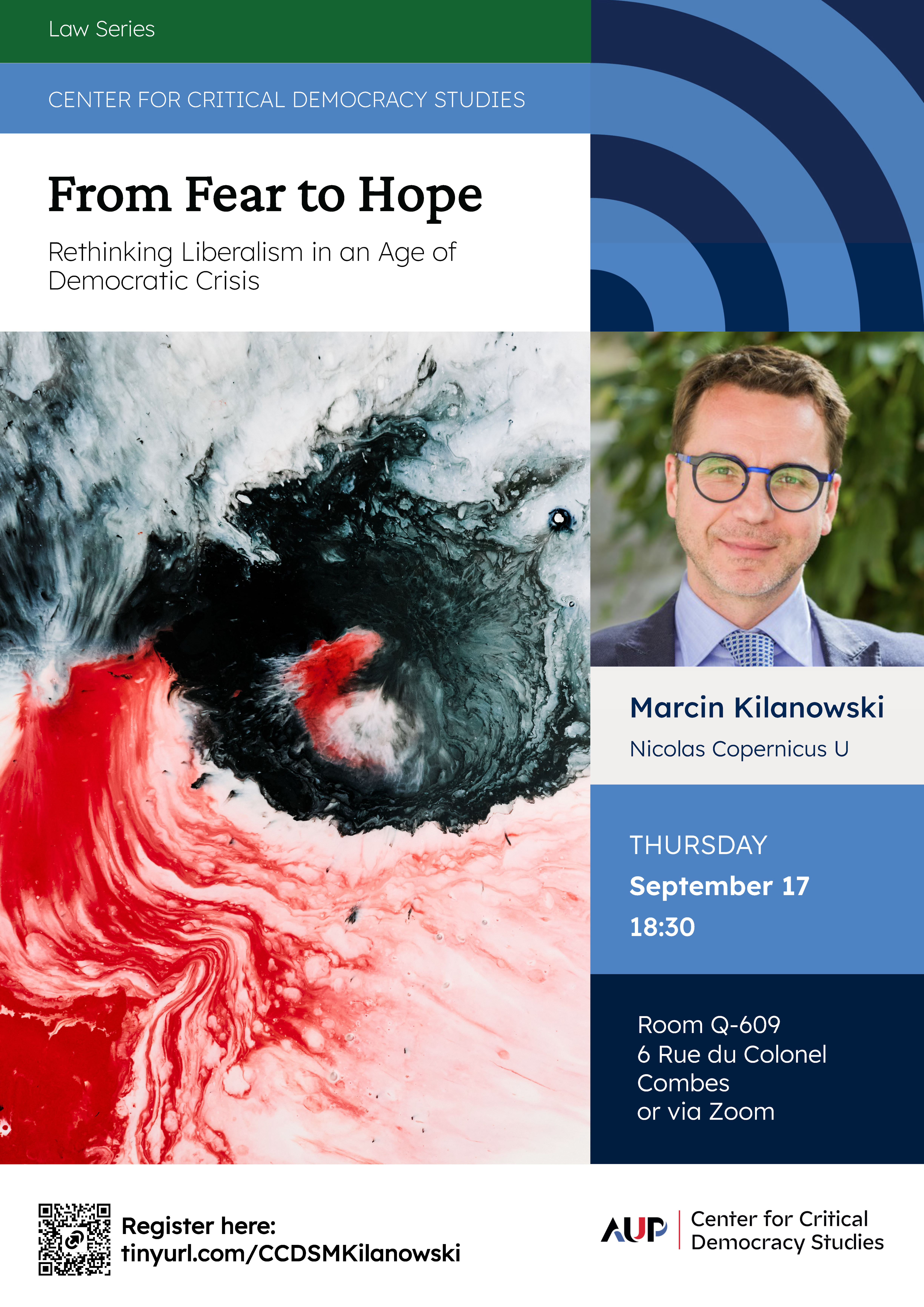
This lecture asks what liberal democracy is for—and what it should offer for the future. It explores the tension between liberalism’s commitment to protecting individuals from arbitrary power and its capacity to promote equality, human development, participation, and social transformation.
At a time of democratic frustration, polarization, and declining trust, the central question is whether defending democracy against its enemies is enough. The presentation argues for democracy that combines protection with emancipation: cautious about power and unintended consequences, yet ambitious about what democratic politics can make possible.
It concludes by asking whether liberal democracy can become a project of hope again—not through utopian promises, but through a credible belief in the possibility of collective improvement.
Bio
Marcin Kilanowski is Professor of law at Nicolas Copernicus University. Previously, he was a postdoc at the Department of Philosophy at Harvard University and a Visiting Scholar at the Institute for Social Research at Johann Wolfgang Goethe University, the Social Science Center in Berlin and the Economics Department at Harvard University. Kilanowski also worked as a law tutor at Harvard College, a docent at the Institute of Global Law and Policy at Harvard Law School and as a Visiting Professor at Sciences Po teaching global governance, human rights and constitutional law. Kilanowski advised various Polish government institutions including the Office of the Prime Minister, the Ministry of Development, and the Ministry of Economy's Working Group on Corporate Social Responsibility. He also served as a member of the UN Global Compact Scientific Council.
Kilanowski studied philosophy and law at Nicolaus Copernicus University, Utrecht University, Oxford University and Harvard University. He received his Ph.D. in philosophy and Habilitation in law from Nicolaus Copernicus University as well J.D. from Nicolaus Copernicus University and LLM from Harvard Law School.