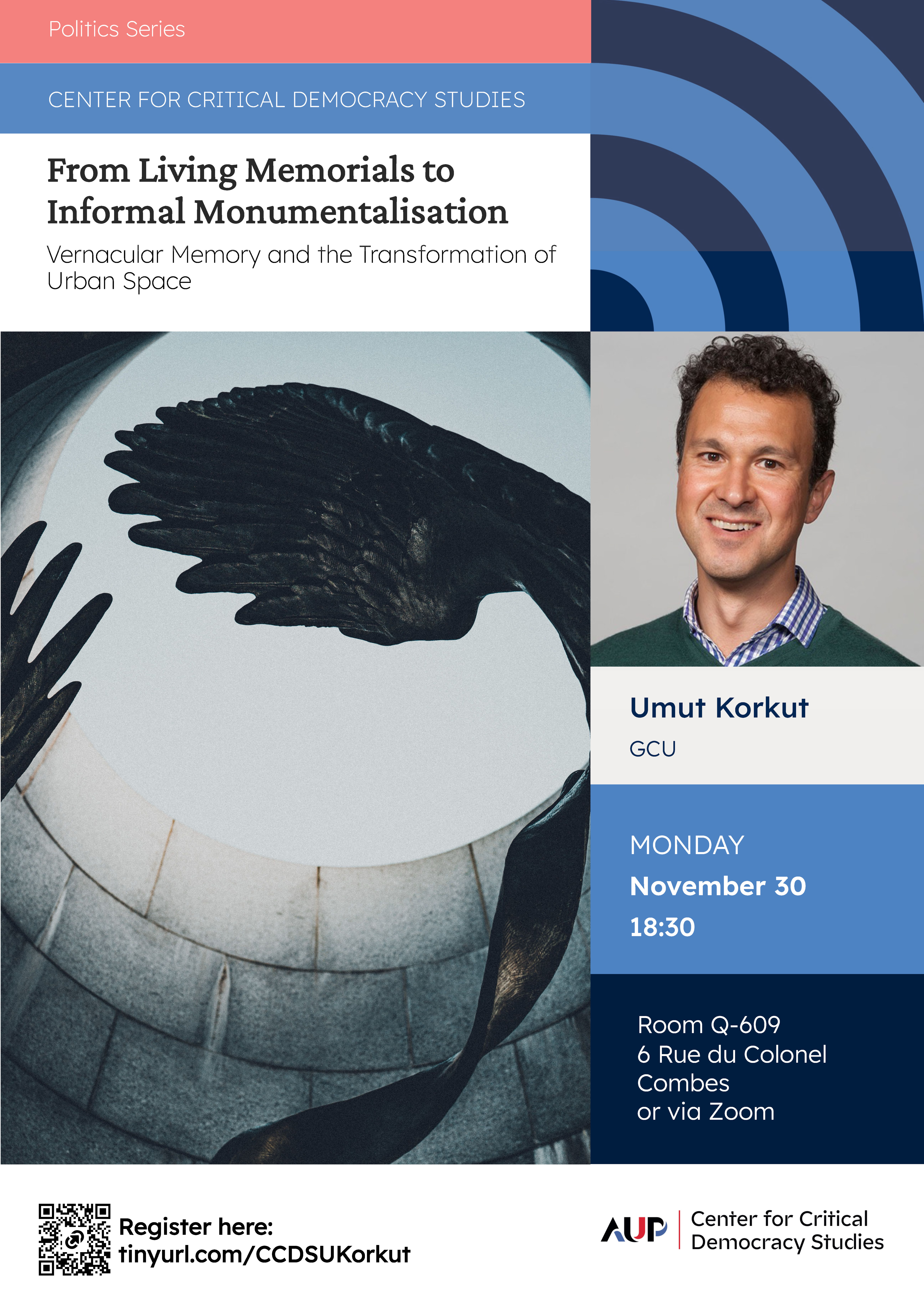
Abstract
How does a monument come into being? Conventional understandings of monumentality in the West tend to privilege the monumental object as a statue, memorial or architectural structure commissioned by a state or institution. They are and intended to endure and impress. Yet traumatic events also generate commemorative practices that emerge outside formal institutions, including photographs, flowers, candles, handwritten messages, posters, stickers and personal objects placed in public space. Although individually ephemeral and often lacking an institutional author, such materials can acquire considerable spatial visibility and symbolic durability through their accumulation. They can define and make space.
This article argues that monumentality should therefore be understood not only as a property of a monumental object, but as a process that can emerge through repeated vernacular acts of remembrance. The article develops this argument comparatively through two cases: the Living Memorial (Élő Emlékmű) on Szabadság tér in Budapest, established in response to the Hungarian government's 2014 German Occupation Monument, and the rapidly developing commemorative landscape that has appeared in Israeli public space following the attacks of 7 October 2023. The cases are neither historically nor politically equivalent. Rather, their differences illuminate distinct routes through which vernacular remembrance can acquire monumental qualities. The Budapest Living Memorial represents an explicitly civic and counter-monumental intervention concentrated around a contested official monument, while the Israeli case consists largely of individually produced photographs, posters, stickers and related commemorative materials dispersed across ordinary urban environments.
Building on scholarship on spontaneous memorialisation, counter-monuments and vernacular memory, the article shifts analytical attention from the individual commemorative object to the spatial effects of accumulation. In the Israeli case, photographs and stickers displaying the faces, names and biographies of those killed have appeared on railway infrastructure, walls, poles, market structures, fountains and other sites of everyday urban activity. Individually, these objects commemorate particular lives; collectively, their repetition and juxtaposition produce a dense visual and affective memorial landscape. Similarly, the Living Memorial demonstrates how ephemeral personal contributions can generate sustained memorial presence through continuing practices of participation, maintenance and interpretation. The article conceptualises this process as informal monumentalisation. We name this the transformation through which dispersed, individually produced and often ephemeral acts of remembrance acquire collective spatial, material and aesthetic monumentality through accumulation. Informal monumentalisation differs from the production of an informal monument because monumentality is emergent rather than designed, distributed rather than concentrated, and potentially temporary rather than necessarily permanent. It also transforms the relationship between commemoration and everyday urban space such as railway stations, walls, poles and market structures retain their ordinary functions while simultaneously becoming sites of memorial meaning. The comparison ultimately suggests that monumentality is relational and processual. It can emerge through repetition, accumulation, biographical representation and the gradual inscription of remembrance into everyday space. Monuments, therefore, do not necessarily have to be built. They can also emerge. This paper relies on fieldwork in Israel in major cities and railway stations in summer 2026.
Bio
Umut Korkut is Professor of International Politics at Glasgow School for Business and Society at Glasgow Caledonian University. He completed his DPhil (magna cum laude) at Central European University in Budapest in 2004. In 2009, he was awarded Associate Professorship by the Turkish Higher Education Council. He became professor in 2018. In the 2005-2006 term, he was a junior fellow at Collegium Budapest Institute for Advanced Study. In 2015-2016, he was a visiting fellow of the Slavic-Eurasian Research Centre at Hokkaido University. He has served the Political Studies Association (PSA) as Trustee and International Projects Lead. In 2018, he was elected to the executive committee of the International Political Science Association (IPSA). He served as the Vice-President of IPSA between 2021-2023 and authored the 2022 IPSA Gender and Diversity Monitoring Report based on a global survey involving 59 political science associations.
He is interested in how political discourse, aesthetics and visual imagery create audiences. He follows this theoretical interest across various empirical fields central to European politics and beyond such as migration and social inclusion, de-radicalisation, arts and culture as participatory democratic tools, internet studies, populism and everyday extremism. He has established expertise in Hungarian and Turkish politics.