AUP students by the Seine.
BOOK ABSTRACT:
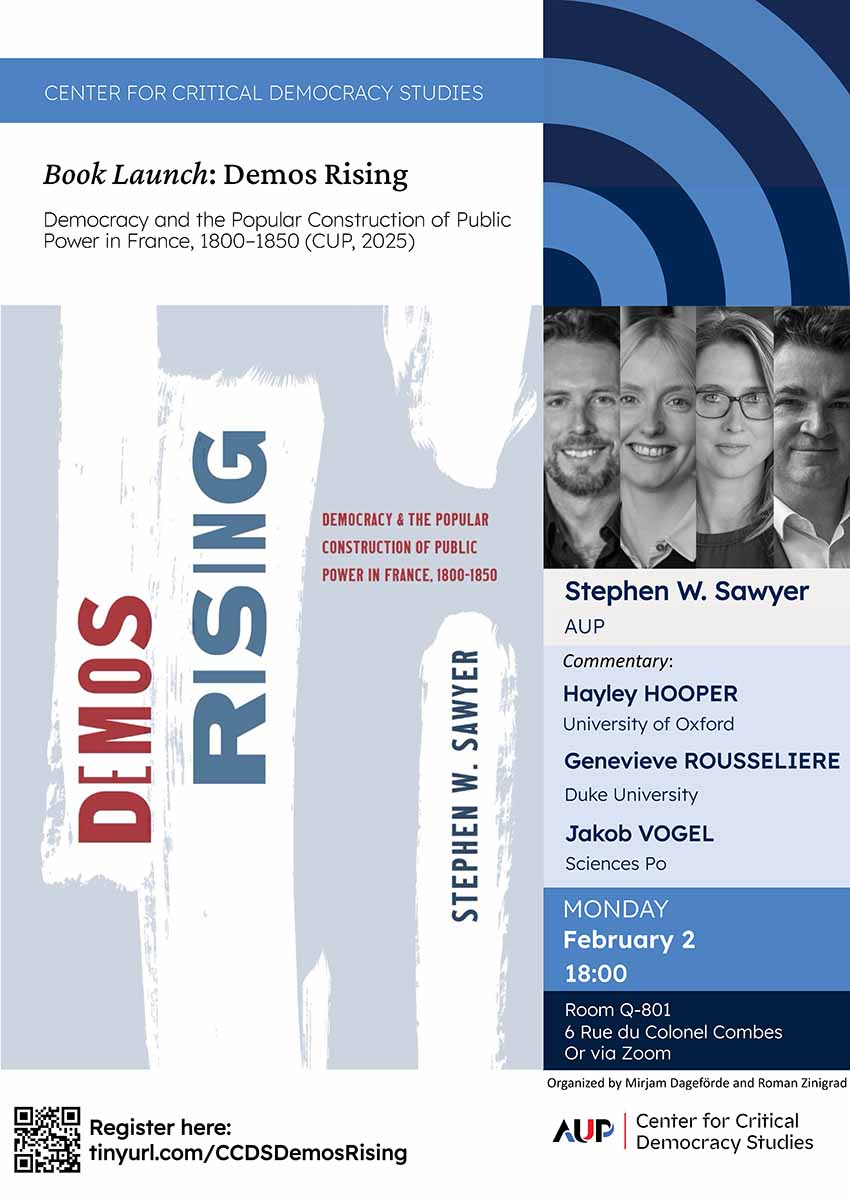
A political history exploring the concept of demos in the French government during the period of 1800 to 1850.
In his previous book, Demos Assembled, Sawyer offered a transatlantic account of the birth and transformation of the modern democratic state. In Demos Rising, he presents readers of political history with a prequel whose ambitious claim is that a genuine demos became possible in France only with the development of government regulation and administration. Focusing on democracy as a form of administration rather than as a form of sovereignty allows Sawyer to explore urban planning, work and private enterprise, health administration, and much more as cornerstones of a self-governing society of equals.
Examining the period between 1800 and 1850, Sawyer studies a set of thinkers who debated at length over the material problems of everyday life, sparking calls for political action and social reform in the face of conflict wreaked by deforestation, urbanization, health crises, labor relations, industrial capitalism, religious tensions, and imperial expansion. The solutions to these problems, Sawyer argues, were sought—and sometimes found—not through elections, as one might assume, but rather through the “care for all” promised by modern administrative power, regulatory intervention, and social welfare programs. By studying this profound transformation in governance, the book wagers, we can better understand the origin and meaning of democracy—even when events in our own time have thrown the concept into doubt. (https://press.uchicago.edu/ucp/books/book/chicago/D/bo239010928.html)
BIOS:
Stephen W. Sawyer is the Ballantine-Leavitt Professor of History and director of the Center for Critical Democracy Studies at The American University of Paris (AUP). In 2020, 2022, and 2023 Sawyer participated in three European Horizon grants, serving as a principal investigator on projects focusing on challenges to contemporary democracy. The core of his multi-volume project articulates a history and theory of democracy as a mode of popular magistrature, administration and public regulation. Sawyer returned to Stanford as the Kratter Visiting Professor in European History in 2022. Sawyer earned his Ph.D. in history at the University of Chicago.
Hayley J. Hooper is an Associate Professor in Law. She is also an academic affiliate of the Bonavero Institute for Human Rights. She holds an LLB from the University of Glasgow, and a Bachelor of Civil Law (BCL), MPhil in Law, and a DPhil in Law from the University of Oxford. Her teaching interests include European Union Law, Constitutional Law, and Administrative Law. Her interests are broadly within the fields of Constitutional Law and Administrative Law. Hayley is the co-author of Parliament's Secret War (Hart: Bloomsbury, 2018). This book concerns war powers in the British Constitution and offers a critical inquiry into the Westminster Parliament's role in relation to the war prerogative since the beginning of the twentieth century. Hayley is also working on a monograph on the closed material procedure, a process that facilitates the use of national security evidence in civil litigation.
Geneviève Rousselière is an Associate Professor of Political Science at Duke University. She received my PhD in Politics from Princeton. Her research interests include modern and contemporary political philosophy, social theory, the history of political economy, feminism, republicanism and democratic thought. Her first book, Sharing Freedom: Republicanism and Exclusion in Revolutionary France (CUP 2024), offers a critical analysis of French republicanism tracing its birth in the uneasy adaptation of an elitist republican tradition to the democratic circumstances of a large and diverse country during the Revolution. Her second book manuscript, The Politics of Self Destruction. Rousseau on Political Economy (CUP, under contract), focuses on Rousseau’s economic thought and its importance for democratic theory.
Jakob Vogel is a professor of European history at Sciences Po Paris and Honorary Professor at the Faculty of History of Humboldt University of Berlin. He was director of the Marc Bloch Centre in Berlin from 2018 to 2023. Vogel's research focuses on contemporary European history and European colonialism. As a specialist of the “long nineteenth century,” he has examined the role of the nation, national and transnational relations, and intra- and extra-European interdependencies. Vogel played a key role in the founding and development of the dynamic field of the History of Knowledge (Wissensgeschichte), which examines the changing place of knowledge in modern societies. More recently, this field has concentrated on the circulation of ideas and academic expertise within European and colonial contexts, particularly in Africa and Latin America.