Students on a theater trip in Iceland.

Critical Democracy Studies

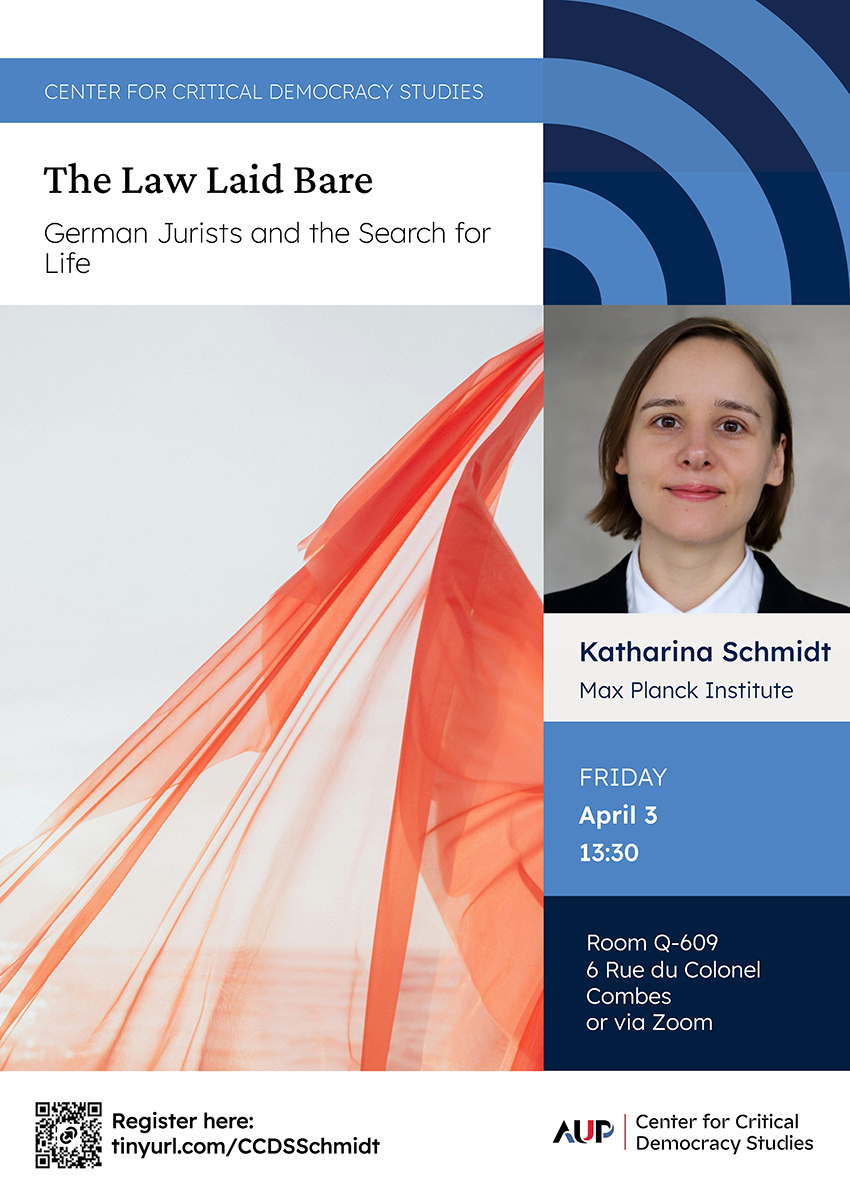
Katharina Isabel Schmidt, "The Law Laid Bare: German Jurists and the Search for Life"

Room: Q-609 - 6 Rue du Colonel Combes, 75007 Paris
Friday, April 3, 2026 - 13:30 to 15:30

ABSTRACT
Ours is a time of withering trust in law and its officials, a time of yearning for alternatives to rule-based governance. Postwar codes and constitutions have not delivered on their promises; their concepts do not solve, they symbolize, the sundry crises of our times. Fiat and algorithms are swooping in to take law’s place, as populists and data scientists pitch justice beyond rules. Yet autocracy and automation are not peculiar to our present moment, and law’s last existential crisis has only just slipped from memory. Once before, around the turn of the twentieth century, lawyers and laypeople rose up against the rule of rules. Law’s lag behind the times, they complained, was a slap in modernity’s face. Nowhere was this charge more forcefully articulated than in Germany, where jurists had always prided themselves on doing law scientifically. Though the Empire’s new Civil Code stood like a monument to legal logic, law-skeptics had been making a home in its crevices and cracks. Reflecting counter-cultural currents in science and religion, literature and the arts, a group of self-styled “free lawyers” probed how far rules bent before they broke. Recalibrating law’s relationship with life, they explored the limits of legal transformation. Because both Nazis and New Dealers flocked to free law, the movement’s legacy remains contested. Recovering law’s forgotten crisis, and placing it alongside our own, The Law Laid Bare reckons with legal modernism’s delicate suspension between thrill and threat, potential and peril, utopia and undoing.

BIO
Katharina Isabel Schmidt is Leader of the Minerva Fast Track Research Group “Artificial Justice.” In this capacity, she heads a team of experts on law, logic, computer science, technology, and the humanities. In her research, Katharina explores the fundamental tension between animation and automation in law. Her first monograph, German Jurists and the Search for Life in Law, traces legal modernism’s long history from 1900 all the way to the Third Reich. In doing so, Katharina pays particular attention to early twentieth-century yearnings for more “human” judges, judges, that is to say, who worked with their hearts, not their minds. Her second book recovers the early history of legal information science against the backdrop of “human failure” under the Nazis, the rise of legal cybernetics in the Soviet Union, and socio-political unrest around 1968. Katharina has training in both law and history, holding degrees from University College London, the University of Cologne, the University of Oxford, the Yale Law School, and Princeton University. She is also a junior fellow at the Hamburg Academy of Sciences.