AUP student taking a photo of the Seine during Orientation.
![]()
Abstract:
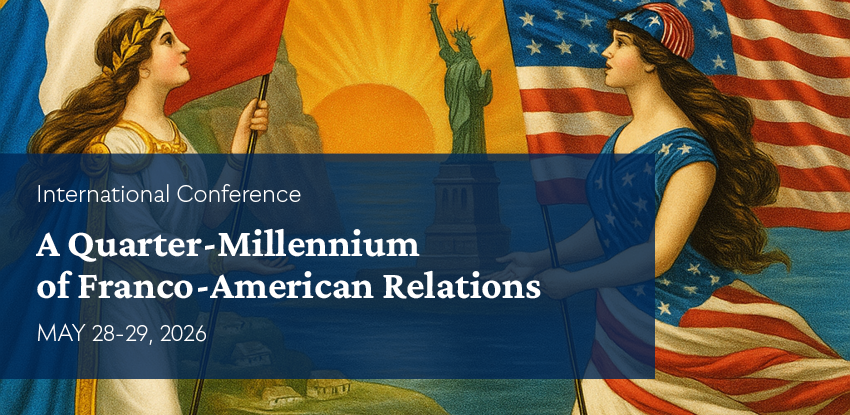
The Tocqueville Society and the Center for Critical Democracy Studies at the American University of Paris, with the support of Princeton University and the Chambrun Foundation, are delighted to sponsor an interdisciplinary conference in Paris on “A Quarter-Millennium of Franco-American Relations,” to be held on May 28-29, 2026, to coincide with the 250th anniversary of the Declaration of Independence.
For the entire existence of the United States, its story has been deeply intertwined with that of France. Secret French aid in 1776-78, and Lafayette’s arrival in America, followed by a formal military alliance, proved crucial for the cause of U.S. independence. In the nineteenth century, France’s sale of the Louisiana territory allowed the United States to expand westward. In the 1880s, France sent the Statue of Liberty as a gift to the Americans. On two occasions in the twentieth century, American armies crossed the Atlantic to fight for France, on French soil.
France and the U.S. remain both formal allies and key trading partners, with millions of their citizens crossing the Atlantic each year to visit the other. Each country also looms large in the other’s literary and artistic imaginations, as exemplified by figures as different as Benjamin Franklin, René de Chateaubriand, James Fenimore Cooper, Claude Monet, Josephine Baker, James Baldwin, Ernest Hemingway, Anna Julia Cooper and Michel Foucault.
There have been tensions and worse, from the Quasi War of 1798-1800 to complex relations with the Union and the Confederacy during the Civil War, de Gaulle’s withdrawal from NATO command, France’s opposition to the Iraq War of 2003, and the current tensions between the U.S. and the European Union. Even as some Americans once warned about “French theory,” now some French critics assail American “wokisme.” And these sister republics, born in the same age of revolution, have always gazed upon each other as into a distorting mirror, hoping that by understanding the other, they will learn to understand themselves. One of the greatest observers of American society and politics was also among the finest observers of French society and politics: Alexis de Tocqueville. In this current moment of international tension, understanding the relationship is more important than ever.