AUP Students Visit the Assemblée Nationale as the French Government Collapses
MAIN MENU
Close
Search
Student Life
AUP Students Visit the Assemblée Nationale as the French Government Collapses
By Savannah Gerlach
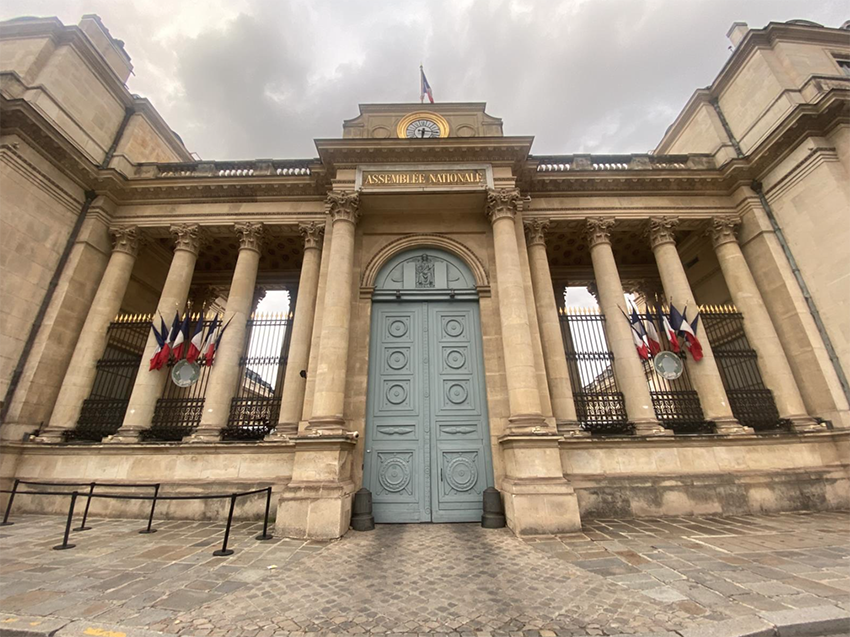
On October 6, 2025, 16 AUP students and Professor Mirjam Dageförde arrived in front of l’Assemblée Nationale de Paris (the National Assembly of Paris), anticipating a guided tour of the nation’s lower house of parliament, and an inside look at democracy in action. What they didn’t expect was to find the French government on the brink of collapse.
Earlier that morning, France’s Prime Minister, Sébastien Lecornu, announced his resignation, less than a month after his appointment and just days before the expected presentation of the draft 2026 budget bill. AUP students watched as journalists and photographers crowded the sidewalk outside, following a story which began last year in June when President Emmanuel Macron called a snap election, resulting in a hung parliament with no clear coalition.
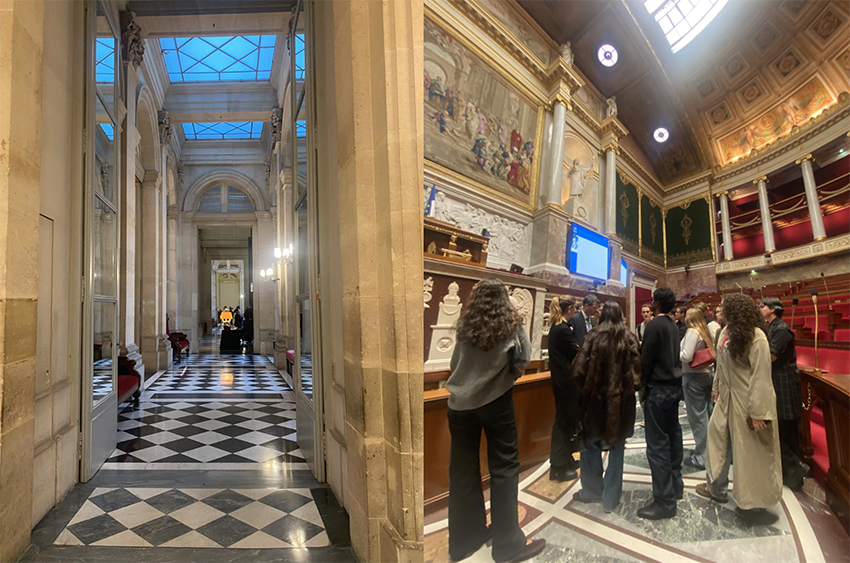
While the morning’s visit—organized by Professor Dageförde for a class on Comparative Politics and following an invitation from Deputy Emmanuel Grégoire—was able to move forward, nothing was as they expected. In the absence of a prime minister or a bill to fund the government, uncertainty hung in the air. Hallways, the press room, and areas where parliamentary bodies would normally gather for debate, were empty and silent.
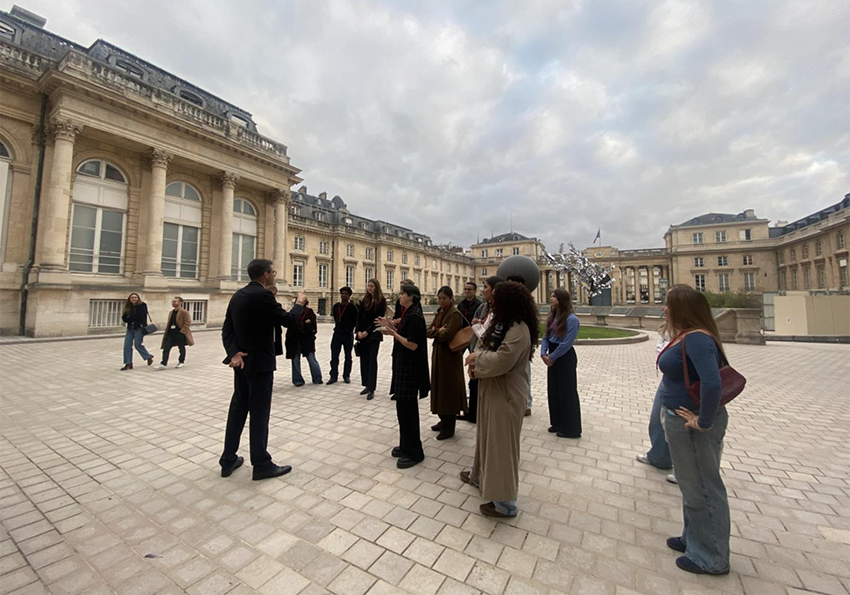
As the students ventured through the building, situated just four blocks from AUP’s campus, they wrote down their first impressions, emotional reactions, unanswered questions, and points of discussion for their next class. Deputy Grégoire, who had planned to meet with students and take their questions at the end of the visit, was no longer available due to the events of the day. Nevertheless, Dageförde saw this moment as a unique opportunity to discuss the rarer iterations of democracy, and for students to examine how a democracy might bend under political strain.
“The goal behind this visit was for students to really get a feeling for what daily political life and functioning is like. I wanted them to learn about the history of this parliamentary body, and the ideas alive in the Assembly,” says Dageförde. The students were surprised by the starkness of the empty building, she says, but excited to see history unfold. “It has inspired them to take a greater interest in politics and become personally involved.”
For some of Dageförde’s students, this class marks their first opportunity to study a democracy outside of their home country. The comparative nature of studying politics, Dageförde says, allows students to examine the pros and cons of varying democratic systems, and sharpens the lens with which we view our home countries. This semester, her students have studied how institutions function, change and persist, grounding their coursework in the writings of Arend Lijphart, Robert A. Dahl, Seymour M. Lipset, Stein Rokkan, and others.
Later this semester, students will devise their own democratic governments and present them to the class, at which point they will need to defend their choices, and debate systems with their classmates. Key questions arise in these moments. What are the links between societies and their politics? Are some systems more compatible with certain cultures? Where can democratic backsliding occur? With over 100 nationalities represented on AUP’s campus, this classroom is uniquely suited to meet these fundamental questions with their own real-life examples.
Many of Dageförde’s students will go on to major in International and Comparative Politics, with others focusing on History, Law and Society. AUP offers a diverse array of majors and minors, as well as master's degrees in Diplomacy and International Law, and International Affairs. While at AUP, students have the flexibility to adapt their majors to fit global career aspirations, and to practice cross-disciplinary study under the tutelage of our world-class faculty.
As the political situation in France develops, Dageförde observes that while Macron’s path forward remains unclear, the semi-presidential system and its democratic foundations are built to last. High fragmentation within France’s parliament, as well as the French president’s languishing approval rating, are some of the risks endemic to this democratic system, she explains, the same way that any variation of democracy is likely to meet challenges under strain. Nevertheless, even within the abandoned halls of the Assemblée Nationale in the nation’s capital, AUP’s students are finding that the spirit of democratic engagement is alive as ever.