
- About AUP
- History of AUP
- Mission & Core Values
- Vision and Leadership
- AUP Recognition
- Alumni Success
- Campus Development
- Arts at AUP
- Policies & Guidelines
- Academics
- Undergraduate
- Graduate Programs
- MA in Diplomacy and International Law
- MA in Global Communications
- MSc in Human Rights and Data Science
- MA in International Affairs
- MA in International Affairs, Conflict Resolution, and Civil Society Development
- MSc in International Management
- MSc in Strategic Brand Management
- Find Your Thesis Advisor
- Previous Programs
- Cultural Program
- Faculty
- Summer School
- Research Centers
- The Center for Critical Democracy Studies
- Upcoming Events
- Fellows’ Publications
- Publishing
- Curriculum
- Community
- Partnerships
- Visiting Scholars
- CCDS Highlights
- Atelier de Théorie Politique – Paris
- Critical Theory 101: Future Directions and New Challenges
- Martti Koskenniemi on “The Law of International Society: A Road not Taken”
- Academic Freedom Symposium
- Tocqueville Colloque 2023
- Violent Turns Conference
- Degenerations of Democracy
- DEMOS21 Inaugural Event
- What Demos for the 21st Century?
- The Paris Centennial Conference
- Justice Stephen Breyer
- Civic Jazz - The Launch of the Center
- Past Events
- Research Projects
- FR
- The Center for Writers and Translators
- The George and Irina Schaeffer Center for the Study of Genocide, Human Rights and Conflict Prevention
- The Joy and Edward Frieman Environmental Science Center
- The Center for Media, Communication & Global Change
- The Center for Critical Democracy Studies
- Departments
- Academic Resources
- Paris as Classroom
- ACE
- Admissions
- Student Life
- Campus
- Student Leadership & Involvement
- Paris
- Support Services
- Student Life Help Desk
- Student Accounting Services
- Student Immigration Services
- Student Grievance Procedure
- Diversity and Inclusion
- Health & Well-being
- Digital Student Handbook
- News
- Events
- AUP Giving
- Housing Offer for 2026-2027
- IT Services
- Alumni
- About AUP
- History of AUP
- Mission & Core Values
- Vision and Leadership
- AUP Recognition
- Alumni Success
- Campus Development
- Arts at AUP
- Policies & Guidelines
- Academics
- Undergraduate
- Graduate Programs
- MA in Diplomacy and International Law
- MA in Global Communications
- MSc in Human Rights and Data Science
- MA in International Affairs
- MA in International Affairs, Conflict Resolution, and Civil Society Development
- MSc in International Management
- MSc in Strategic Brand Management
- Find Your Thesis Advisor
- Previous Programs
- Cultural Program
- Faculty
- Summer School
- Research Centers
- The Center for Critical Democracy Studies
- Upcoming Events
- Fellows’ Publications
- Publishing
- Curriculum
- Community
- Partnerships
- Visiting Scholars
- CCDS Highlights
- Atelier de Théorie Politique – Paris
- Critical Theory 101: Future Directions and New Challenges
- Martti Koskenniemi on “The Law of International Society: A Road not Taken”
- Academic Freedom Symposium
- Tocqueville Colloque 2023
- Violent Turns Conference
- Degenerations of Democracy
- DEMOS21 Inaugural Event
- What Demos for the 21st Century?
- The Paris Centennial Conference
- Justice Stephen Breyer
- Civic Jazz - The Launch of the Center
- Past Events
- Research Projects
- FR
- The Center for Writers and Translators
- The George and Irina Schaeffer Center for the Study of Genocide, Human Rights and Conflict Prevention
- The Joy and Edward Frieman Environmental Science Center
- The Center for Media, Communication & Global Change
- The Center for Critical Democracy Studies
- Departments
- Academic Resources
- Paris as Classroom
- ACE
- Admissions
- Student Life
- Campus
- Student Leadership & Involvement
- Paris
- Support Services
- Student Life Help Desk
- Student Accounting Services
- Student Immigration Services
- Student Grievance Procedure
- Diversity and Inclusion
- Health & Well-being
- Digital Student Handbook
- News
- Events
- AUP Giving
- Housing Offer for 2026-2027
- IT Services
- Alumni
Related Links
Academics
Professors Perry and Roda Win UNESCO Prize for their Research on the Ethics of AI
Home>News>
By Kristin Sanders
AUP professors Susan Perry and Claudia Roda have always been ahead of the curve. As a human rights specialist and data scientist, respectively, each has spent her career exploring the bigger picture of technology, data collection, machine and human learning, human rights and ethics. They began collaborating in their research—creating AUP’s MSc in Human Rights and Data Science in 2021, the first of its kind—long before the cross-disciplinary field was recognized globally.
While it may be rare for a human rights scholar and a scientist to work together, the result is fruitful and, in today’s world, increasingly necessary. Ask either about privacy laws or AI in the classroom, and you’ll receive forward-thinking theory, principles designed to maximize student success and protect human rights, and expertise stemming from decades of research, but also ideas from the heart. Their work is the embodiment of brilliance, passion, and care for the real people—workers, students, creatives, and kids—whose lives are impacted by technology’s breakneck advances.
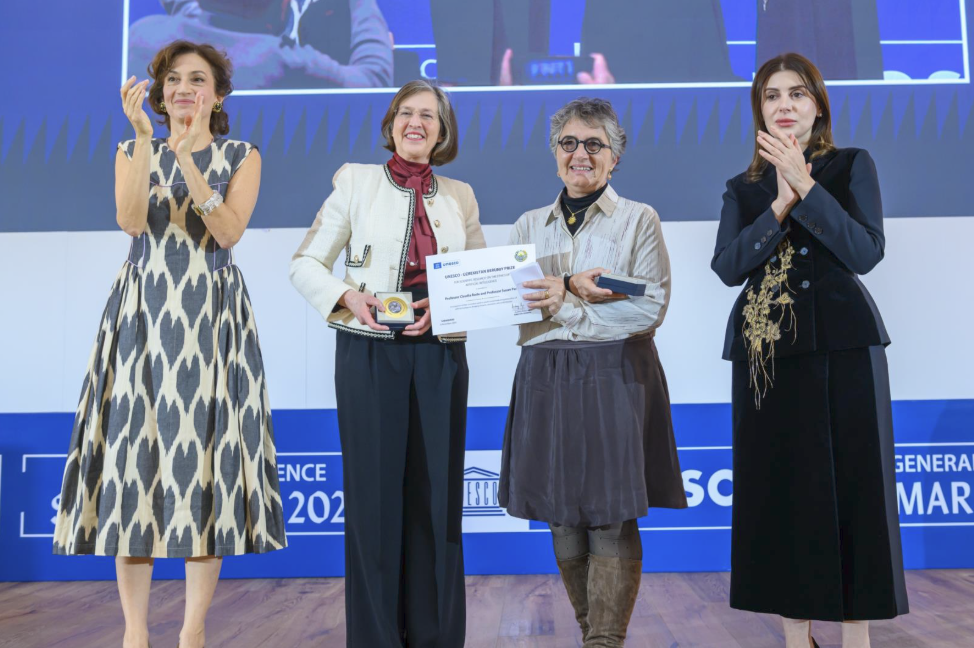
On November 6, UNESCO awarded Drs. Perry and Roda the inaugural UNESCO-Uzbekistan Beruniy Prize for Scientific Research on the Ethics of AI, recognizing their years of interdisciplinary collaboration and advances in the fields of human rights and data science as trailblazing. The ceremony took place at the UNESCO General Conference in Samarkand, Uzbekistan, where the jury also recognized fellow laureates Professor Virgilio Augusto Fernandes de Almeida, Professor Emeritus of Computer Science at the Federal University of Minas Gerais, and the Institute for AI International Governance (I-AIIG) at Tsinghua University.
When it comes to the integration of AI into our daily lives, education, work, and personal relationships, professors Perry and Roda argue that the emphasis on efficiency is where we humans currently have it all wrong. Their primary concern? Our humanness.
As a specialist in international human rights law and digital technology, Dr. Perry, a Franco-American who has been teaching at AUP since 1988, is deeply concerned with the ethical questions around AI, seeking “the best and most ethical solution for the broadest number of people.” Dr. Roda, a Franco-Italian professor of computer science who arrived at AUP in 1997, first worked in the field of agentic AI in 1989, applying her research to industrial process control.
In the early 2000s, Dr. Roda joined forces with an EU-funded research group to explore the use of AI agents to support children’s learning. The project achieved powerful results, but required collecting sensitive information about children, prompting the question at the core of Drs. Perry and Roda collaboration: how can technology help people while also protecting their rights?
In 2012, the two began collaborating on publications and an EU-funded grant to support privacy-by-design, aiming to build privacy protections into the software itself and soon created a Human Rights and Digital Technology class at AUP, exchanging expertise and research interests while co-authoring scholarly articles on a range of related topics. In 2017, the two co-authored a book, Human Rights and Digital Technology: Digital Tightrope. Their dedication to scholarship, collaboration, and friendship saw them through the Covid-19 pandemic, where they formed a pod that enabled them to continue working together in person. “When we’re able to meet face to face, we get an incredible amount done,” Dr. Perry explains, affirming their belief in the significant power of human connection.
It comes as no surprise, then, that the duo co-created AUP’s MSc in Human Rights and Data Science (HRDS), which Dr. Roda directs. The coursework bridges two fields, with an option to attend AUP’s Summer Institute for Human Rights. Graduates emerge well positioned for jobs at the intersection of digital technologies and policy, finding roles such as Data Ethics Analyst, Quantitative Researcher, Data Analyst, Head of Digital Communication in sectors like international institutions, publishing firms, and local governments, where they apply and formulate policy around technology and AI within a human rights framework.
To Dr. Perry, “AUP is the place to be for work in this field. Our network is truly extensive—not just with other researchers, but with industry, policymakers, and civil society, interfacing with a range of thinking. You come to AUP to plug into that network.”
For those who are interested in—or worried about—the rapid progression of AI, especially within the field of education, Drs. Perry and Roda have published reassuring evidence that students benefit from a strict structuring of knowledge transfer and a great deal of time for discussion. What this means for students in a classroom, whether toddlers learning to read or university students preparing for careers, is that a thoughtful, reflective use of technology needs to be coupled with a great deal of discussion.
Having guided student learning for decades, and witnessing the acceleration of generative AI, Dr. Roda explains that “students are listening. They care. They do want to do things well, and using bots, often, adds nothing to the learning experience.” Dr. Perry agrees, noting that students, especially at AUP, “understand and are committed to fine tuning their humanness in a technology environment. Students are looking for this kind of approach or framework within which to become extremely good critical thinkers in a world of technology.”
Neither professor is inherently against AI. Instead, they promote the preservation of our humanness, values that are articulated in their “Five Principles for AI in Education,” first presented to UNESCO and designed to be adapted to universities worldwide. They advocate for: a classroom experience based on human interaction; the use of technology only when it can assist human teachers and students to achieve their goals; an institutional commitment to ‘human oversight by design’; shared oversight with students on AI decision-making; and the registration of all algorithms used to deliver education and student services in a transparent data base. They have been collaborating with AUP’s Jeff Gima and AMICAL to exchange views with universities in the Global South on University Charters on AI.
An example of these principles in action, and of the youth-centered focus of their work, is the project “Tinker Tales,” created with a U.S. nonprofit organization called First Book that provides books to help children learn to read. After discovering that not all children recognize themselves in beginner reading books, the duo, along with Eli Hinson '25, created a prototype for an AI system that allows teachers to guide students in creating their own stories, which are then illustrated to reflect the students’ personal worlds. “The children learn how to create different types of stories, and they have a hands-on experience of AI,” Dr. Roda explains. In addition to supporting reading skills and creative learning, the project ensures that the children’s data is protected and aims to create a tool that can be used globally, even in rural places without internet connection.
Drs. Perry and Roda are now co-writing a second book with a closer focus on AI. AUP, with its small class sizes, nurturing relationships between students and professors, and its focus on human interaction, has been a good laboratory for their research.
Out of the intimate, intellectual space they have forged, Drs. Perry and Roda have emerged as pioneers in the intersection of human rights and digital technology, having been among the first to frame the field, publish articles supporting its interdisciplinarity, receive funding grants and prizes for their research and its practical application, and create products that put their theory into practice.
The heart of their work as professors lies in encouraging students to discover and articulate their humanness. AUP’s nurturing, student-centric, and cutting-edge environment is one key step towards that vision.