- About AUP
- History of AUP
- Mission & Core Values
- Vision and Leadership
- AUP Recognition
- Alumni Success
- Campus Development
- Arts at AUP
- Policies & Guidelines
- Academics
- Undergraduate
- Graduate Programs
- MA in Diplomacy and International Law
- MA in Global Communications
- MSc in Human Rights and Data Science
- MA in International Affairs
- MA in International Affairs, Conflict Resolution, and Civil Society Development
- MSc in International Management
- MSc in Strategic Brand Management
- Find Your Thesis Advisor
- Previous Programs
- Cultural Program
- Faculty
- Summer School
- Research Centers
- The Center for Critical Democracy Studies
- Upcoming Events
- Fellows’ Publications
- Publishing
- Curriculum
- Community
- Partnerships
- Visiting Scholars
- CCDS Highlights
- Atelier de Théorie Politique – Paris
- Critical Theory 101: Future Directions and New Challenges
- Martti Koskenniemi on “The Law of International Society: A Road not Taken”
- Academic Freedom Symposium
- Tocqueville Colloque 2023
- Violent Turns Conference
- Degenerations of Democracy
- DEMOS21 Inaugural Event
- What Demos for the 21st Century?
- The Paris Centennial Conference
- Justice Stephen Breyer
- Civic Jazz - The Launch of the Center
- Past Events
- Research Projects
- FR
- The Center for Writers and Translators
- The George and Irina Schaeffer Center for the Study of Genocide, Human Rights and Conflict Prevention
- The Joy and Edward Frieman Environmental Science Center
- The Center for Media, Communication & Global Change
- The Center for Critical Democracy Studies
- Departments
- Academic Resources
- Paris as Classroom
- ACE
- Admissions
- Student Life
- Campus
- Student Leadership & Involvement
- Paris
- Support Services
- Student Life Help Desk
- Student Accounting Services
- Student Immigration Services
- Student Grievance Procedure
- Diversity and Inclusion
- Health & Well-being
- Digital Student Handbook
- News
- Events
- AUP Giving
- Housing Offer for 2026-2027
- IT Services
- Alumni
- About AUP
- History of AUP
- Mission & Core Values
- Vision and Leadership
- AUP Recognition
- Alumni Success
- Campus Development
- Arts at AUP
- Policies & Guidelines
- Academics
- Undergraduate
- Graduate Programs
- MA in Diplomacy and International Law
- MA in Global Communications
- MSc in Human Rights and Data Science
- MA in International Affairs
- MA in International Affairs, Conflict Resolution, and Civil Society Development
- MSc in International Management
- MSc in Strategic Brand Management
- Find Your Thesis Advisor
- Previous Programs
- Cultural Program
- Faculty
- Summer School
- Research Centers
- The Center for Critical Democracy Studies
- Upcoming Events
- Fellows’ Publications
- Publishing
- Curriculum
- Community
- Partnerships
- Visiting Scholars
- CCDS Highlights
- Atelier de Théorie Politique – Paris
- Critical Theory 101: Future Directions and New Challenges
- Martti Koskenniemi on “The Law of International Society: A Road not Taken”
- Academic Freedom Symposium
- Tocqueville Colloque 2023
- Violent Turns Conference
- Degenerations of Democracy
- DEMOS21 Inaugural Event
- What Demos for the 21st Century?
- The Paris Centennial Conference
- Justice Stephen Breyer
- Civic Jazz - The Launch of the Center
- Past Events
- Research Projects
- FR
- The Center for Writers and Translators
- The George and Irina Schaeffer Center for the Study of Genocide, Human Rights and Conflict Prevention
- The Joy and Edward Frieman Environmental Science Center
- The Center for Media, Communication & Global Change
- The Center for Critical Democracy Studies
- Departments
- Academic Resources
- Paris as Classroom
- ACE
- Admissions
- Student Life
- Campus
- Student Leadership & Involvement
- Paris
- Support Services
- Student Life Help Desk
- Student Accounting Services
- Student Immigration Services
- Student Grievance Procedure
- Diversity and Inclusion
- Health & Well-being
- Digital Student Handbook
- News
- Events
- AUP Giving
- Housing Offer for 2026-2027
- IT Services
- Alumni
Related Links
Students on a theater trip in Iceland.
Critical Democracy Studies
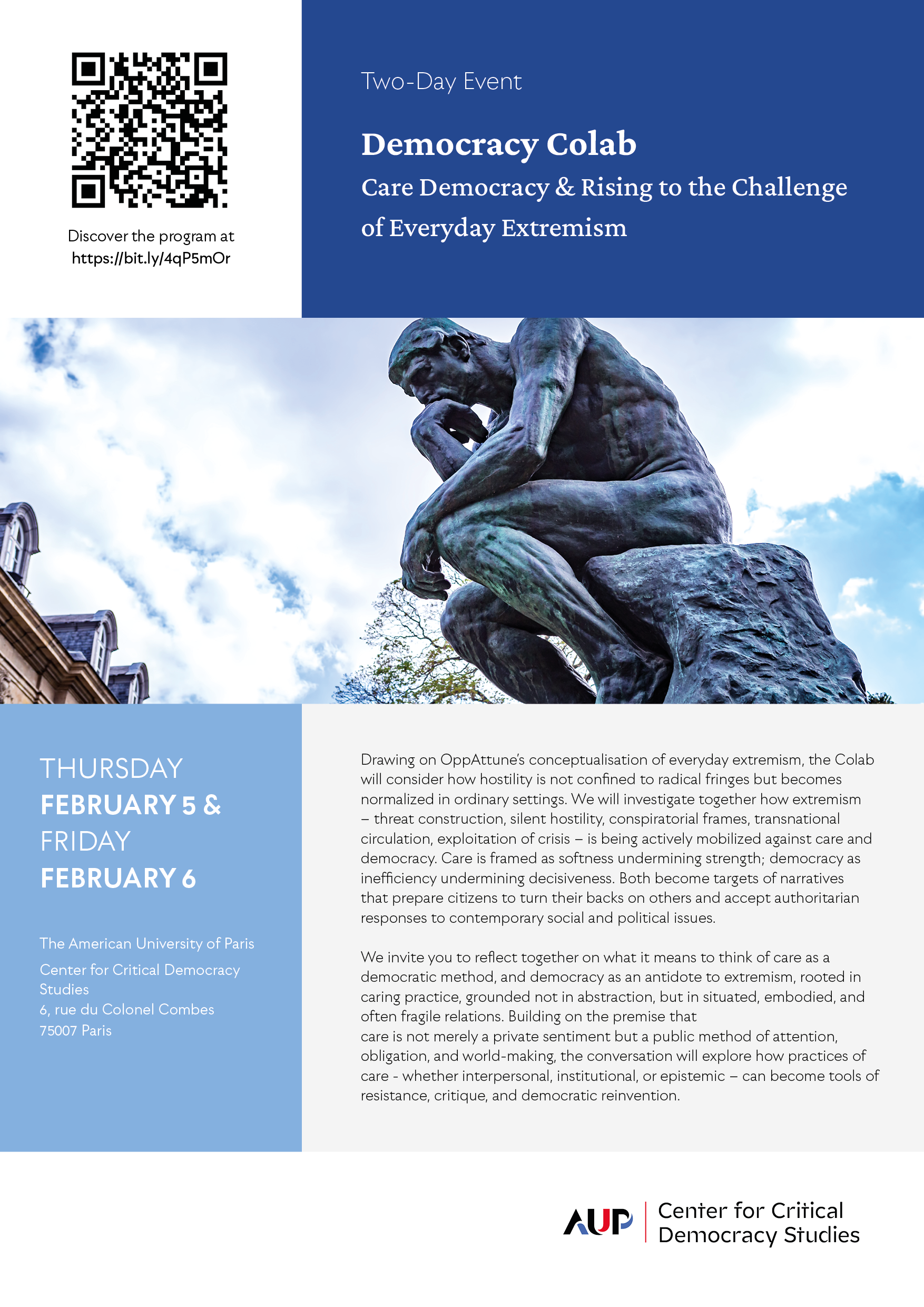
Democracy Colab: Care Democracy & Rising to the Challenge of Everyday Extremism
Drawing on OppAttune’s conceptualisation of everyday extremism, the Colab will consider how hostility is not confined to radical fringes but becomes normalized in ordinary settings. We will investigate together how extremism – threat construction, silent hostility, conspiratorial frames, transnational circulation, exploitation of crisis – is being actively mobilized against care and democracy. Care is framed as softness undermining strength; democracy as inefficiency undermining decisiveness. Both become targets of narratives that prepare citizens to turn their backs on others and accept authoritarian responses to contemporary social and political issues.
While care and democracy are often treated as separate spheres – one emotional or private, the other rational and public – the idea of Care Democracy offers a different perspective: that they build upon and sustain one another, and that they can create counter-narratives. An essential component of this Democracy Collab will be to examine how this perspective sheds light on the role of gender in the development of everyday extremism. Anti-gender mobilizations – attacks on feminism, LGBTQAI+ rights, and reproductive justice – converge with anti-care and anti-democracy narratives, delegitimizing interdependence and solidarity. Everyday Extremism appears to be gendered, and this finding is emerging across methods, different nations, online and offline spaces within OppAttune and other related projects. Against this backdrop, the Democracy Colab takes up the hypothesis that when care is devalued, withdrawn, or commodified, democracy begins to hollow out. And when democratic institutions erode, infrastructures of collective care collapse with them. Gender is central to this process, as both care and democracy depend on the recognition of interdependence, equality, and embodied vulnerability.
At its most concrete, care ethics holds that our responsibilities do not arise only from laws or abstract principles but from the concrete relationships that sustain life. It emphasizes 1attentiveness to others, responsiveness to their needs, and the responsibility to maintain the networks of support on which we all depend. Originating in feminist philosophy (Carol Gilligan, Joan Tronto), care ethics insists that dependence and vulnerability are not defects to be overcome but the very conditions of human existence, and that families, institutions, and societies must organize themselves to sustain these interdependencies fairly and justly.
The aim of this two-day event is to open a dialogue and enhance political attunement around a simple but urgent proposition: care and democracy are not parallel ideals, but mutually constitutive practices. To care is to enact a form of democratic attention; to democratize is to extend the field of those whose needs, voices, and vulnerabilities matter. The first day will be focused on stimulating talks and the second-day on workshops and activities in the form of a student academy.
We invite you to reflect together on what it means to think of care as a democratic method, and democracy as an antidote to extremism, rooted in caring practice, grounded not in abstraction, but in situated, embodied, and often fragile relations. Building on the premise that care is not merely a private sentiment but a public method of attention, obligation, and world-making, the conversation will explore how practices of care - whether interpersonal, institutional, or epistemic – can become tools of resistance, critique, and democratic reinvention.
Key Questions
- In what ways do gender, nationalism and extremism intersect?
- How are narratives against care, democracy, and gender being mobilized within everyday extremism? or How do narratives of care, democracy, and gender become targets of everyday extremism?
- In what ways do anti-care, anti-democracy, and anti-gender discourses converge across Europe and beyond?
- How can the Attunement Model help sustain dialogue in the face of hostility, and counter the erosion of solidarities?
- What would it mean to practice care as a democratic method, and democracy as a caring practice, in institutions, media, and everyday life?
- How can students, practitioners, and scholars together generate counter-narratives that frame care as strength, democracy as survival, and gender justice as foundational?
- Are there additional epistemological and operational benefits to building a specific concept of 'caring dialogue' or 'caring social dialogue', or even 'careful dialogue'? Could the implicit ambivalence of the concept of 'careful dialogue' as both caring and cautious be particularly valuable in alerting us to the need for sophisticated practices & skills that sensitively combine self-care and care for others in the face of constant threats to care, democracy and liberties?
- In what ways can the concepts of health and ecology contribute to a Care Democracy Model?
- What relevance do the societal areas of education and legislation/law enforcement have for a Care Democracy Model?
- How should the relationship between the concepts of care and liberty be conceptualised?